Quick facts
- Size
- 16–20 inches long and 3.2–3.4 pounds (CPW)
- Hind foot
- 4.6–5.8 inches long, the snowshoe that gives the hare its name
- Share of the lynx's diet
- About 70% in Colorado (CPW)
- Coat
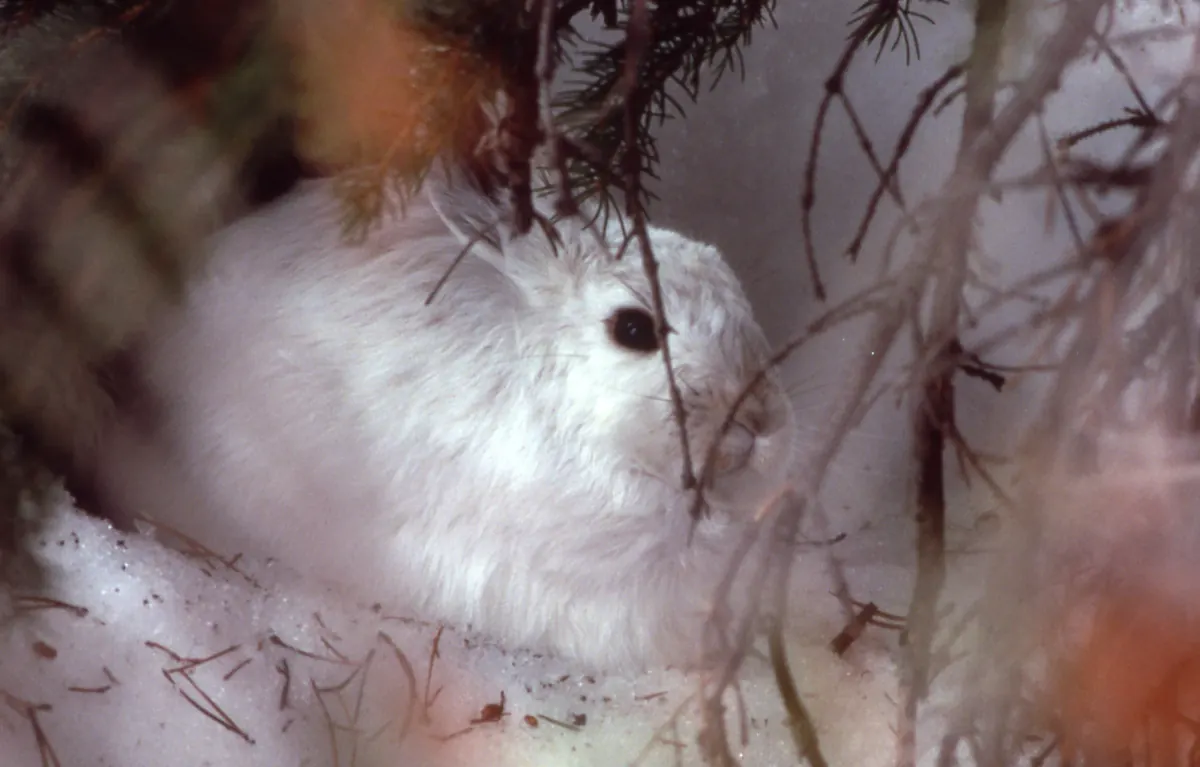
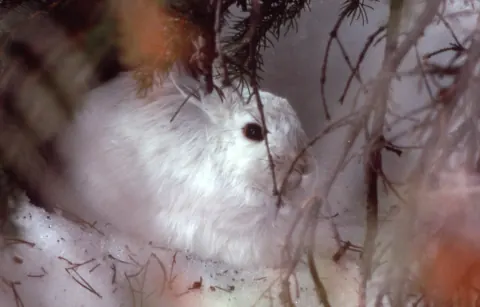
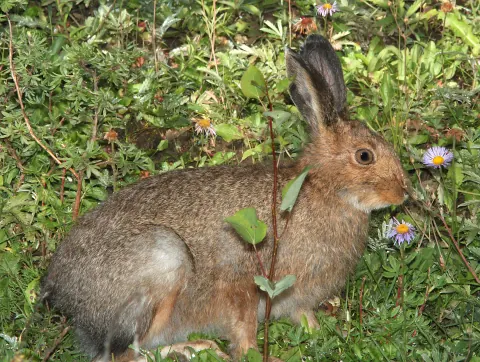
- Grizzled rusty or grayish brown in summer; bright white in winter
- Where in Colorado
- Most of the mountains, except the southeastern Front Range
- Litters
- Two a year, of five young, between March and August
Overview
The snowshoe hare is the quiet half of one of Colorado’s best-known predator-prey pairs. Colorado Parks and Wildlife says hares make up about 70 percent of the diet of the Canada lynx, the state-endangered, federally threatened cat reintroduced to the San Juan Mountains. Where hares are scarce, lynx go hungry; where cover keeps hares abundant, lynx can raise kittens.
The hare itself is named for its oversized, bristly hind feet, which carry it over deep snow. CPW gives its length as 16.3 to 20.4 inches and its weight as usually 3.15 to 3.42 pounds, with males slightly smaller than females. Twice a year it changes color: grizzled rusty or grayish brown with a blackish line down the back in summer, bright white in winter. That molt is now a liability as snow seasons shorten.
Snowshoe hares are not rare. NatureServe ranks the species S5 (secure) in Colorado.
Habitat in Colorado
CPW places snowshoe hares in subalpine forests, often in willow thickets, across most of Colorado’s mountains except the southeastern Front Range. They are vegetarians, eating tender herbs in summer and woody twigs and bark in winter, and they produce two litters of five young a year between March and August.
Not every forest holds the same number of hares. A CPW study led by Jacob Ivan tracked hares in west-central Colorado from July 2006 to March 2009 in three kinds of stand: mature Engelmann spruce-subalpine fir, young even-aged lodgepole pine, and mid-aged lodgepole pine that had been thinned. In every forest type and season, densities were below one hare per hectare (2.5 acres). In summer they were highest in young lodgepole (0.20 to 0.66 hares per hectare), lowest in thinned mid-aged lodgepole (0.01 to 0.03), and in between in mature spruce-fir (0.01 to 0.26). Annual survival was highest in mature spruce-fir. The authors recommended that managers keep mature spruce-fir and young lodgepole stands rather than thinned, mid-aged lodgepole to benefit hares, and by extension lynx.
The lynx connection
From 1999 to 2009, CPW researchers followed lynx tracks in the snow to find where the cats chased and killed prey. Snowshoe hares were the primary winter food in Colorado, especially by total biomass consumed, with red squirrels making up most of the rest. Lynx caught a hare on 31 percent of attempts. Hunting success peaked at sites with roughly 3,000 stems per hectare and was lower in denser vegetation, where hare densities were higher, which means the thickest patches act as refuges for hares. The study recommended managing for mature, uneven-aged spruce-fir stands, which naturally mix dense and open patches so that hares can thrive and lynx can still reach them.
Primary Threats
- Coat-color mismatch: a hare that is white on bare ground is easy to see. A study of wild snowshoe hares through three winters of widely varying snowpack found that the hares could speed up or slow down the spring molt from white to brown, but could not shift when color change starts or how fast the fall molt runs. With climate projections showing snowpack lasting 29 to 35 fewer days by mid-century and 40 to 69 fewer days by the end of the century, the authors estimated that without evolutionary change, the number of days a white hare sits on a snowless background would rise four- to eightfold by 2100. A follow-up with radio-collared hares measured the cost: hares mismatched with their background suffered weekly survival decreases of up to 7 percent, enough to drive strong population declines by the end of the century unless natural selection on molt timing keeps pace.
- Forest thinning and clearing: CPW names deforestation and climate change as the primary threats. The Colorado density study found the fewest hares in thinned, mid-aged lodgepole, which removes the horizontal cover hares need.
Climate change and drought covers how shrinking snowpack affects Colorado’s mountain species.
Conservation and Management
The snowshoe hare has no listing and no recovery plan of its own. Its conservation rides on the lynx: the 2024 federal recovery plan for the Canada lynx centers on keeping connected subalpine habitat and managing snowshoe hare populations across the Southern Rockies, and CPW’s hare and lynx studies point the same way. The practical recommendation from both is the same: keep mature spruce-fir and young, dense lodgepole on the landscape.
What You Can Do
- Look for the tracks. In winter, the hare’s wide hind prints in soft snow under spruce and fir are far easier to find than the hare.
- Log sightings on iNaturalist. Note the coat color and the date; records of brown hares on snow or white hares on bare ground help track mismatch.
- Support forest management that keeps cover. Dense young lodgepole and mature spruce-fir hold the most hares, and the lynx that depend on them.
Frequently asked questions
- Why do snowshoe hares turn white?
- Camouflage. The winter coat matches the snow, and a hare that turns white before the snow comes, or stays white after it melts, is easier for predators to see. What that costs them, and why warmer winters make it worse, is under Primary Threats.
- What eats snowshoe hares in Colorado?
- Above all the Canada lynx: CPW says hares make up about 70% of its diet here, and a CPW tracking study found hares were its main winter food by biomass (The lynx connection). The Canada lynx profile tells that side of the story.
- Where do snowshoe hares live in Colorado?
- In subalpine forest, often in willow thickets, across most of the state's mountains except the southeastern Front Range, according to CPW. Which stands hold the most hares is under Habitat in Colorado.
- How can you tell a snowshoe hare from a cottontail?
- By the feet and the season. CPW puts a snowshoe hare's hind foot at 4.6 to 5.8 inches, and of the two only the snowshoe hare turns white for winter; the two coats are compared under Habitat in Colorado.
- Are snowshoe hares endangered in Colorado?
- No. NatureServe ranks the species secure (S5) in Colorado and it is not listed. It is here because the state-endangered lynx cannot persist without it.