Quick facts
- State amphibian
- Since 2012 (C.R.S. 24-80-911.4)
- Range in Colorado
- Statewide, from high mountains to the lowest river valleys (CPW)
- Subspecies here
- Barred and Arizona tiger salamanders (NatureServe)
- Size
- Under 14 inches long
- Collecting
- License and CPW course required since May 1, 2026
- Colorado rank
- S5, secure (NatureServe)
Overview
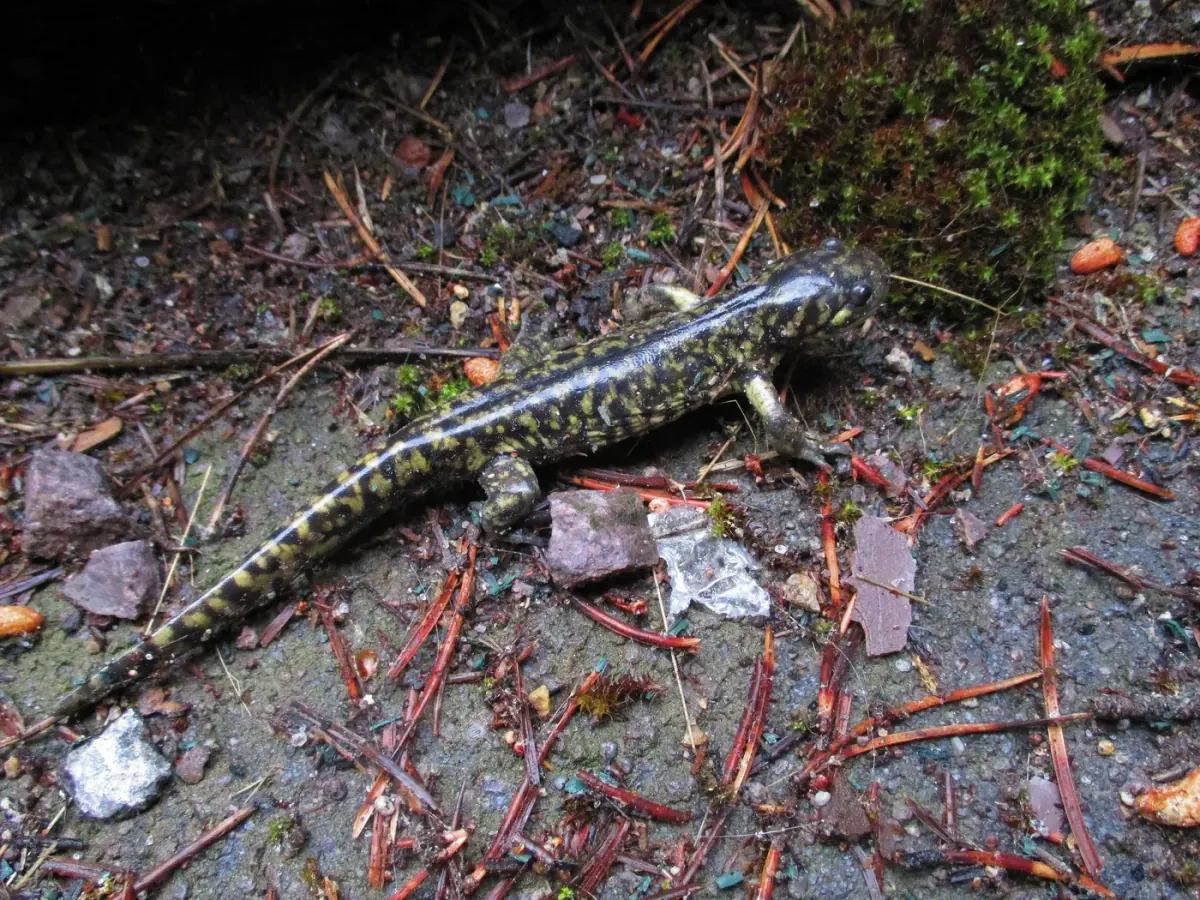
The western tiger salamander is Colorado’s state amphibian. The law, C.R.S. 24-80-911.4, says the “western tiger salamander (ambystoma mavortium) is hereby made and declared to be the state amphibian of the state of Colorado.” A Denver elementary school class suggested the designation, and the bill was signed on March 16, 2012, the Associated Press reported. NatureServe lists it as the only salamander species native to Colorado.
It is a stocky salamander with smooth, moist, sometimes sticky skin, a long tail, a broad head, small eyes and four toes on each front foot. Its color ranges from black with yellowish bars or spots to pale with dark spots or mottling. Adults are less than 14 inches long, and CPW calls it one of the largest land salamanders in North America.
Western tiger salamanders were long lumped with the eastern tiger salamander as Ambystoma tigrinum, the name CPW’s species page still uses; the two are now treated as separate species. NatureServe lists two subspecies in Colorado: the barred tiger salamander (A. m. mavortium) and the Arizona tiger salamander (A. m. nebulosum). A 2021 genetic study found only two major lineages within the species, one of them matching the Arizona tiger salamander.
The species is common and secure: NatureServe ranks it S5 in Colorado. It is on this site as the state amphibian and a familiar animal of Colorado’s ponds and wetlands.
Habitat in Colorado
Tiger salamanders live statewide, from the high mountains to the lowest river valleys, CPW says. They breed in lakes, reservoirs, ponds and pools. On land they usually stay in rodent burrows and come out mostly at night in damp weather.
They have kept their historical range in Colorado’s Rocky Mountains and Great Plains and remain easy to find and locally abundant where the habitat suits them, NatureServe says; ponds often hold up to several thousand larvae. The many small, fishless ponds people have built have given them new habitat, which they are quick to colonize.
Natural History
Females attach their eggs singly or in small clusters to underwater plants and other objects. Larvae hatch without legs; the front legs grow first. Large larvae have three conspicuous pairs of gills. Newly transformed salamanders leave their ponds in late summer or early fall.
Adults that never leave the water
Not every larva transforms. Some keep their gills and larval body and become sexually mature in the water, breeding without ever leaving their pond, CPW says. Biologists call these permanently aquatic adults paedomorphs. In a study of a mountain population of Arizona tiger salamanders, transformed adults grew more than the aquatic ones, because they could reach temporary ponds full of fairy shrimp that the aquatic adults could not.
Cannibal larvae
In some ponds a share of the larvae develop into a cannibal form, with a larger head than typical larvae and prominent teeth. A study at a kettle pond at 2,890 meters (about 9,480 feet) near Gothic, in Gunnison County, found that only the cannibal larvae ate other salamanders, mostly right after the two forms split. Later the cannibals switched largely to plankton, the typical larvae’s main food, yet still took in more prey by weight.
Primary Threats
Trout in mountain lakes
Many mountain lakes that once held tiger salamanders now have few or none because of trout stocking; trout easily eat and deplete the larvae, NatureServe says. A study in and around Gunnison County found the absence of fish was the most important factor in whether tiger salamanders were present, and trout and salamanders rarely occur together in Rocky Mountain National Park. See nonnative fish.
Disease
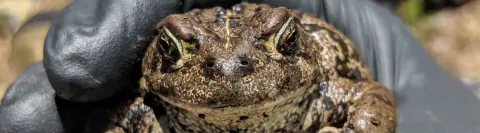
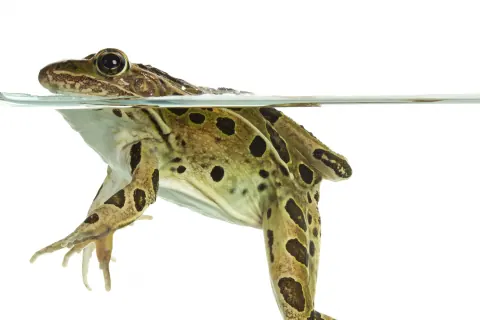
Larval die-offs that appear to be caused by bacteria have been seen in Colorado. Tiger salamanders also carry chytrid fungus and ranavirus. CPW says both tiger salamanders and bullfrogs can carry chytrid fungus without showing signs or dying in large numbers, so moving them can spread the fungus to other amphibians. In Colorado, chytrid fungus is the main reason the boreal toad is state endangered; USFWS has also noted that tiger salamanders and bullfrogs host ranavirus, which can kill the tadpoles of frogs like the northern leopard frog. See chytrid fungus.
Conservation and Management
CPW’s Chapter W-7 herpetofauna rules, in effect May 1, 2026, added the western tiger salamander to the short list of native reptiles and amphibians that Colorado residents may collect from the wild, “to allow for limited take.” Collecting requires a Resident Herpetofauna Collection and Possession License, which a resident gets after passing a CPW course. A license holder may take a combined total of four animals a year from the list, by hand or dip net, may hold no more than 12 at once, may not sell or trade them, and must report each one. Releasing any reptile or amphibian is unlawful except as CPW allows.
Colorado’s fishing rules have separately allowed anglers to take the gilled, water-dwelling form, called a “water dog,” as bait: up to 50 a day, under 5 inches long, with a fishing license. In August 2026, CPW asked the Parks and Wildlife Commission to consider banning any amphibian, alive or dead, as fishing bait. Bait salamanders and bullfrogs that are dumped or escape can spread ranavirus, chytrid fungus and Batrachochytrium salamandrivorans (Bsal), a newer chytrid that can sicken and kill salamanders, CPW wrote. Utah and Wyoming already have such bans. The proposal had not been adopted as of October 2026.
What You Can Do
- Watch, don’t move. Enjoy salamanders and their larvae where you find them; never carry them, their eggs or pond water to another pond.
- Never dump bait or release a pet amphibian.
- Clean, drain and dry boots, waders and nets between wetlands to avoid spreading chytrid fungus.
- Found one indoors? Colorado’s rules let you move a wild salamander, unharmed, out of a house or building to an unconfined spot right outside.
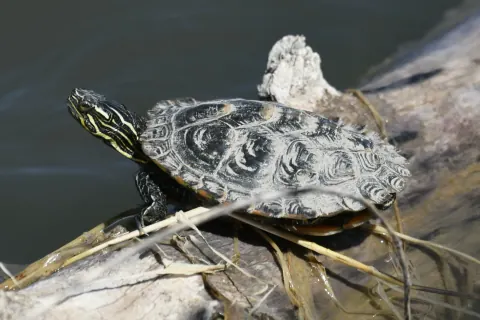
- Explore related species. Read the boreal toad and western painted turtle profiles.
Frequently asked questions
- What is a water dog?
- Anglers' name for the gilled, water-dwelling form of the tiger salamander. Colorado's fishing rules let licensed anglers take up to 50 a day, under 5 inches long, for bait, but CPW proposed in 2026 to ban amphibians as bait; see Conservation and Management.
- Do tiger salamanders eat each other?
- Some larvae do. In some ponds a share of them develop into a cannibal form with a bigger head and prominent teeth; the Natural History section has the Colorado study.
- Is it legal to collect a tiger salamander in Colorado?
- Only with a Resident Herpetofauna Collection and Possession License, which requires passing a CPW course. A license holder may take four animals a year in total from the list of collectible species, may not sell them and may never release them.
- How did the tiger salamander become Colorado's state amphibian?
- A Denver elementary school class suggested it, and the bill was signed into law on March 16, 2012, the Associated Press reported. The salamander is found in every Colorado county, the AP noted.