Quick facts
- Federal status
- Under review; 12-month finding due June 30, 2027
- CPW conservation tier
- Tier 1 Species of Greatest Conservation Need (2025 State Wildlife Action Plan)
- Elevation in Colorado
- About 3,315–7,000 ft (CPW)
- Where in Colorado
- Mostly the eastern plains; valid records from Moffat and Delta counties (CSU)
- Colorado rank
- S2S3, imperiled to vulnerable (NatureServe)
- Rangewide decline
- Nearly 90% in the last two decades, CPW estimates
Overview
The American bumble bee is one of the largest bumble bees in North America, CPW says. It has a vast range across most of the United States but is largely absent from much of the mountain West, so in Colorado it is a bee of the plains and the lower Front Range, including towns and cities.
It was once among the most common bumble bees in North American collections, NatureServe says. Its decline since then is why it is here: CPW’s 2025 State Wildlife Action Plan lists it in Tier 1, the species that need conservation action most urgently, and NatureServe ranks it imperiled to vulnerable in Colorado. The U.S. Fish and Wildlife Service is weighing whether it needs federal protection.
Habitat in Colorado
CPW describes a low-elevation bee found mainly in grassland, and also in urban areas (its elevation range is in Quick facts). CSU Extension’s checklist of Colorado’s bumble bees places it mostly on the eastern shortgrass prairie, with valid records west of the mountains in Moffat and Delta counties.
It is a generalist that visits many kinds of flowers. CPW names key food plants including milkvetch (Astragalus), thistles (Cirsium), prairie clover (Dalea), coneflowers (Echinacea), sunflowers (Helianthus), gayfeather (Liatris) and clovers (Trifolium). NatureServe says it nests mostly on the ground surface among long grass, and sometimes underground; CPW says queens typically pick an old rodent burrow or natural cavity.
Natural History
Each colony lasts one year, CPW says. A mated queen comes out of her winter burrow in spring, finds a nest site, and raises the first workers herself. After that the workers forage and tend the young, and the queen stays in the nest laying eggs. In fall the colony produces males and new queens; the new queens feed, mate and dig in for the winter, and the rest of the colony dies.
The American bumble bee is also a host. NatureServe names it the host of the variable cuckoo bumble bee, a social parasite that raises its young in other bumble bees’ colonies, and a 2022 petition to list that cuckoo pointed to the loss of its host. The cuckoo profiled on this site, Suckley’s cuckoo bumble bee, depends mainly on the western bumble bee instead.
Primary Threats
CPW names four threats:
- Managed bees. Commercial bumble bees and European honey bees can spread disease to wild bumble bees, and honey bees can outcompete them for flowers. Pathogen spillover is the reason USFWS gave in 2021 for opening a status review. NatureServe adds that declining American bumble bees carry higher levels of the parasite Nosema bombi and lower genetic diversity than stable species.
- Pesticides. Exposure through direct contact, pollen, nectar and residue in the soil, with lethal and sublethal effects. NatureServe cites a study that linked use of the fungicide chlorothalonil to higher Nosema infection in declining bumble bees.
- Habitat loss. The bee needs flowers through the whole growing season and places to nest.
- Climate change. It affects the bees directly and through changes to their habitat.
No Colorado trend has been published. CPW’s rangewide estimate is in Quick facts; NatureServe estimated in 2018 that the bee’s range had shrunk by about 20%, with the steepest losses in the north, where it appears to be gone from parts of Maine and Vermont.
Federal Status
- February 1, 2021: the Center for Biological Diversity and the Bombus Pollinators Association of Law Students of Albany Law School petitioned USFWS to list the American bumble bee as endangered.
- September 29, 2021: USFWS found that the petition presented substantial information that listing may be warranted, and began a status review.
- December 17, 2024: under a settlement filed in federal court in Arizona, USFWS agreed to make its 12-month finding by June 30, 2027.
The bee has not been proposed for listing. In January 2026 USFWS took comments on a draft nationwide Conservation Benefit Agreement for bumble bees on energy and transportation lands, from the University of Illinois at Chicago. It covers 11 bumble bees, including the American, western and Suckley’s cuckoo bumble bees, and would let enrolled landowners carry on their work if any of them were listed.
Conservation and Management
Bumble bees came under CPW’s wing only recently: a 2024 state law gave CPW the authority to study invertebrates. CPW is now working with the Xerces Society on the Mountain States Bumble Bee Atlas, a community science survey of the region’s bumble bees. Its 2025 State Wildlife Action Plan puts six Colorado bumble bees in Tier 1, among them the American bumble bee, the western bumble bee, Suckley’s cuckoo bumble bee and the variable cuckoo bumble bee.
What You Can Do
CPW suggests three things:
- Plant native flowers that bloom across the whole growing season, from spring to fall.
- Avoid pesticides, both herbicides and insecticides.
- Report bumble bees. Post photos to iNaturalist or Bumble Bee Watch, or join the Mountain States Bumble Bee Atlas. A photo of the face, thorax and abdomen helps tell the American bumble bee from its look-alikes.
Frequently asked questions
- How do you tell an American bumble bee from other bumble bees?
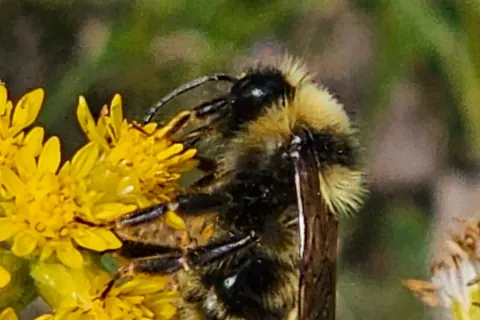
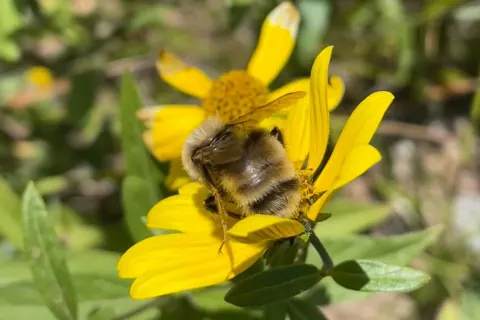
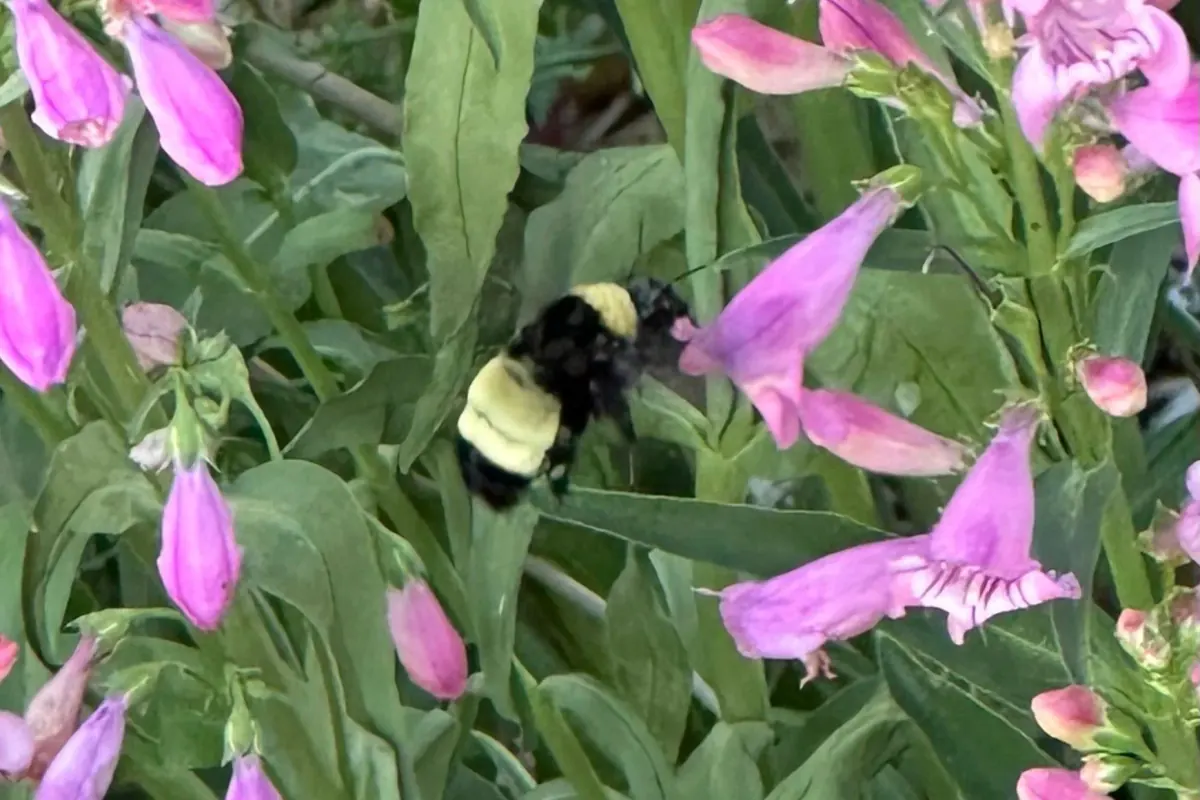
- Look at the face and the tail end. CPW says it has a fully black face, a yellow band across the thorax in front of the wings, yellow on the second and third abdominal segments and black on the last three. CSU counts 23 bumble bee species in Colorado, so a clear photo helps (What You Can Do).
- Do American bumble bees sting?
- Females can. CSU Extension says workers will readily defend a colony that is disturbed, and that unlike honey bees they can sting more than once because the stinger does not detach. Males have no stinger.
- Is the American bumble bee the same as the western bumble bee?
- No. They are different species with different Colorado ranges: the American bumble bee is a plains bee, and the western bumble bee was formerly common from the Front Range west. Both are under federal review (Federal Status).