Quick facts
- Where in Colorado
- Around North Park; upper Colorado River tributaries in Grand County; upper Laramie River (CPW)
- Elevation
- Mainly 7,900–9,800 feet
- Colorado rank
- S3, vulnerable (NatureServe)
- State status
- State Special Concern; SWAP Species of Greatest Information Need (CPW, 2025)
- Size
- Head and body up to about 3.3 inches
- Breeding
- Mainly May–June, in shallow sedge-filled ponds
Overview
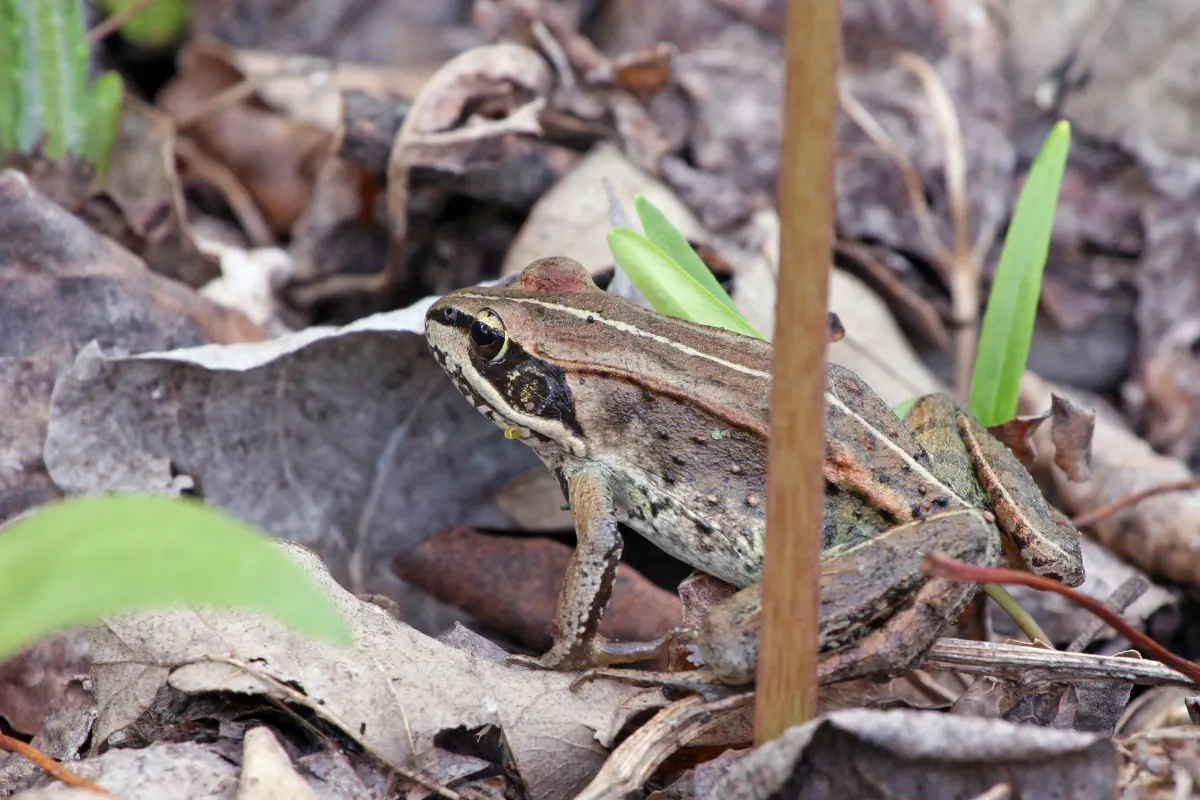
The wood frog is a small brown frog with a dark “mask” on each side of the face, a ridge along each side of the back and, usually, a light stripe down the middle of the back. Adults reach about 83 millimeters (3.3 inches) from snout to vent, and females are more brightly colored than males, CPW says.
It is a frog of the far north. Its range reaches farther north than that of any other North American amphibian, from northern Alaska across boreal Canada, and it runs in a spotty line south through the Rocky Mountains to northern Colorado, NatureServe says. Wood frogs survive winter frozen: the heart stops beating and breathing stops, and ice forms between the cells while the cells themselves stay unfrozen.
CPW lists the wood frog as a State Special Concern species. Its 2025 State Wildlife Action Plan names it a Species of Greatest Information Need, a group CPW says needs more research before its conservation need can be fully assessed. NatureServe ranks it S3, vulnerable, in Colorado.
Habitat in Colorado
Colorado’s wood frogs live in three areas, CPW says: the mountains around North Park, the upper tributaries of the Colorado River in Grand County, and the upper Laramie River drainage in Larimer County. Most live between 7,900 and 9,800 feet, and they are locally fairly common where the habitat suits them.
They use the subalpine zone’s marshes, bogs, pothole ponds, beaver ponds, lakes, stream borders, wet meadows and willow thickets, and the lodgepole pine, spruce, fir and aspen forest bordering them.
Natural History
Wood frogs breed in shallow ponds, mainly in May and June. Breeding ponds often hold thick sedges and may dry up in summer. Females lay egg masses about the size of a baseball or tennis ball, usually several hundred eggs, attached to sedges in shallow water and often on the north side of the pond. Tadpoles turn into small frogs usually in July and August.
Primary Threats
A relict population
USGS scientists studied the wood frogs of Rocky Mountain National Park, which they describe as a relict population, in a landscape where “recent disturbances have altered hydrologic processes and fragmented amphibian habitat.” Their 2012 genetic study found the population split into two genetic clusters, with little movement between them and low genetic variability. In the park’s Kawuneeche Valley, breeding wood frogs used about 12% of the wetlands over three years of surveys, 2004 to 2006. See habitat loss.
Chytrid fungus
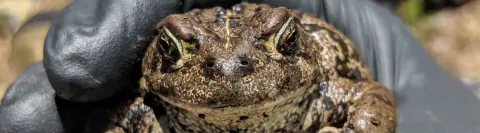
Chytrid fungus was detected in wood frogs and boreal chorus frogs in the Kawuneeche Valley from specimens collected in June 2001. The same fungus drove the decline of Colorado’s boreal toad, which shares the high country with the wood frog. See chytrid fungus.
Recovery & Conservation
The wood frog has no federal listing and no recovery plan. In Colorado it is a State Special Concern species, and CPW’s 2025 plan lists it among the species that most need more research.
The USGS team suggested that the Rocky Mountain National Park population could be helped by spreading it across more of the landscape and by improving gene flow between its two clusters, for example by building or restoring wetlands in the ground between them.
Under CPW’s 2026 herpetofauna rules, the wood frog is not on the list of native species that may be collected from the wild, and releasing any reptile or amphibian is unlawful except as CPW allows.
What You Can Do
- Listen in May and June for the duck-like chorus at high-country ponds, and watch from the bank.
- Clean, drain and dry boots, waders and nets before moving between wetlands, so you don’t spread chytrid fungus.
- Never move frogs, tadpoles or water between ponds.
- Report sightings; see Report a Sighting.
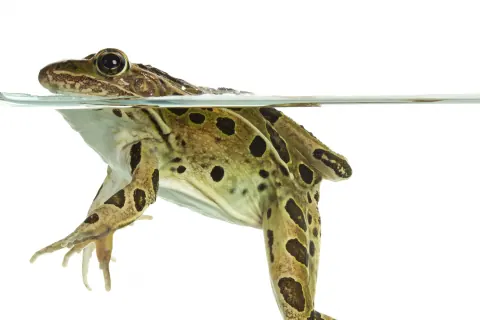
- Explore related species. Read the northern leopard frog and boreal toad profiles.
Frequently asked questions
- How does a wood frog survive being frozen?
- Its heart stops and it stops breathing, and ice forms between its cells while the cells themselves stay unfrozen, CPW says. In spring it thaws and carries on.
- What does a wood frog sound like?
- A rapid series of one to eight rough, clacking notes, usually three to five. CPW says a chorus sounds somewhat like a group of softly quacking domestic ducks; listen for it in May and June.
- Are Colorado's wood frogs a separate species?
- No. A 1990 checklist treated the Colorado and Wyoming frogs as their own species, "Rana maslini," but most authorities do not recognize it, NatureServe says. The Rocky Mountain National Park population does show its own genetic structure; see Primary Threats.