Quick facts
- Where in Colorado
- Northwestern Colorado; seven populations, about 6,000–9,000 ft (CPW)
- Leks
- More than 500 known in northwestern Colorado (CPW)
- State status
- State Special Concern; SWAP Tier 1 (CPW, 2025)
- Federal status
- Not listed; 2015 finding: listing not warranted
- Colorado rank
- S3, vulnerable (NatureServe)
- Weight
- Males often 4–5 lb or more; hens 2–3 lb (CPW)
Overview
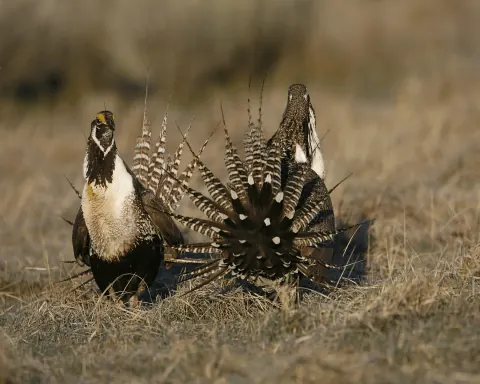
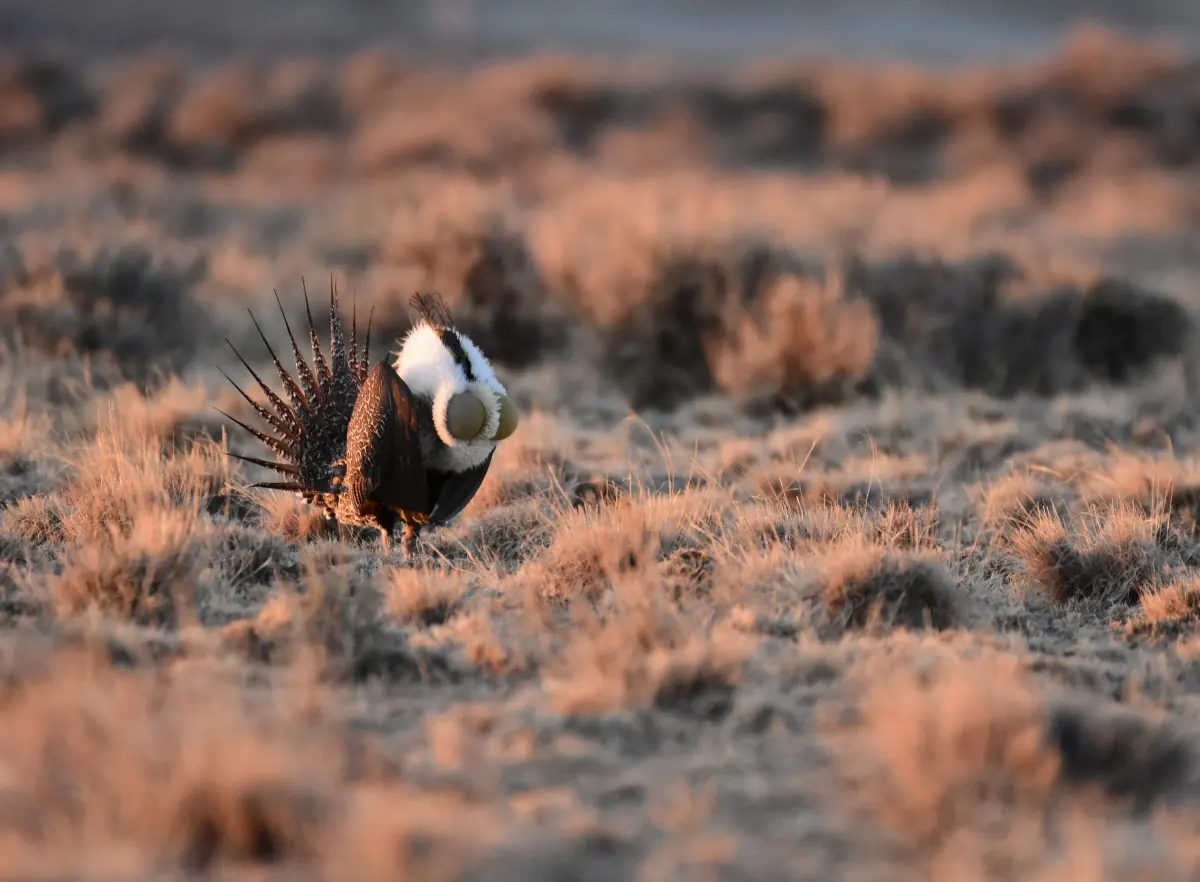
The greater sage-grouse is the largest grouse in North America. In spring, males gather on open patches in the sagebrush called leks, puff out a white chest ruff that hides two yellow-green air sacs, fan a crown of pointed tail feathers, and strut with swishes, pops and growls. Hens watch, choose a male, then nest in the surrounding sagebrush.
Colorado has two sage-grouse, and they are separate species. The greater sage-grouse lives in the northwestern part of the state. The Gunnison sage-grouse, recognized as its own species in 2000 and federally threatened since 2014, lives in southwestern Colorado and southeastern Utah.
CPW lists the greater sage-grouse as a State Special Concern species and, in its 2025 State Wildlife Action Plan, a Tier 1 Species of Greatest Conservation Need because of historical declines and ongoing threats to its habitat. NatureServe ranks it S3, vulnerable, in Colorado and G3 across its range. NatureServe estimates the species declined about 40% from 2002 to 2021, and 78.4% since the 1960s.
Habitat in Colorado
Colorado is the southeastern edge of the bird’s range, which spans sagebrush country in 11 western states and two Canadian provinces. CPW recognizes seven populations here: Northwest Colorado, North Park, Middle Park, Northern Eagle–Southern Routt, Parachute-Piceance-Roan, Meeker–White River and Laramie River. About 20% of the state’s birds live in North Park.
The birds live where sagebrush is abundant, usually at 6,000 to 9,000 feet, on open flats, slopes, ridges and plateaus. They are not forest grouse. From late fall to spring they stay almost entirely in sagebrush, which gives them food and cover; in summer and early fall they also use grassland, aspen, greasewood and farm fields near it.
Hens lay 7 to 9 eggs. In early summer they lead their broods to moister ground near sagebrush, such as higher sagebrush-grasslands, shallow draws and irrigated hay meadows, where chicks find the insects and wildflowers they eat. See the sagebrush shrubland page.
Primary Threats
Losing and breaking up sagebrush
CPW lists energy development and land use, residential and commercial development, sagebrush removal and conversion to farmland, and transportation corridors among the threats in Colorado. NatureServe names the loss, fragmentation and degradation of sagebrush as the underlying cause of declines across the range. CPW studies in the Parachute-Piceance-Roan population found that breeding and wintering hens chose places with less disturbed ground and, in the breeding season, farther from busy well pads. See habitat loss.
Invasive weeds, fire and encroaching trees
CPW names invasive weeds and pinyon-juniper encroachment, trees spreading upslope onto sagebrush ridges. NatureServe adds that more frequent wildfires let nonnative annual grasses and weeds take over. See invasive plants and wildfire.
Drought
NatureServe says predation and drought have very high impacts on population size in many areas of the West. See climate change and drought.
Recovery & Conservation
The federal status has changed three times without the bird ever being listed. USFWS found listing not warranted in 2005. In March 2010 it found listing “warranted, but precluded” by higher priorities, which made the bird a candidate. On October 2, 2015, after reviewing new state and federal conservation plans, it found listing “not warranted at this time.” A separate population on the California–Nevada border, the Bi-State population, was proposed as threatened in 2023; it does not include Colorado birds.
On federal land, the Bureau of Land Management manages sagebrush through plan amendments. BLM approved the current Colorado amendments, part of its Greater Sage-Grouse Rangewide Planning, in January 2025. Amendments for Idaho, Montana and the Dakotas, Nevada and California, Utah and Wyoming followed in December 2025; BLM said those plans make “more acres available in some areas for development than the 2015 plans allowed.”
CPW says it has worked on the greater sage-grouse for more than 25 years. It protects private land with conservation easements, has cleared thousands of acres of encroaching pinyon-juniper, restores water flow to wet meadows used by broods, and counts males on leks each spring with other agencies. CPW says local working groups coordinate conservation planning for five of the state’s sage-grouse populations.
What You Can Do
- Watch leks from a distance. Stay in your vehicle and keep quiet while the birds display.
- Keep to roads and trails in sagebrush, and clean seeds off vehicles, boots and pets so you don’t spread cheatgrass and other weeds.
- Prevent wildfire in sagebrush country, where fire helps cheatgrass take over.
- Report sightings, especially outside the known populations; see Report a Sighting.
- Compare its cousin. Read the Gunnison sage-grouse profile.
Frequently asked questions
- Do greater and Gunnison sage-grouse live in the same places?
- No. CPW says their ranges are roughly separated by the Colorado River: greater sage-grouse live in northwestern Colorado, and Gunnison sage-grouse in southwestern Colorado and southeastern Utah. How to tell the two apart is on the Gunnison sage-grouse profile.
- What do sage-grouse eat in winter?
- Almost nothing but sagebrush. CPW says sagebrush leaves and buds make up more than 99% of their winter diet, which is why the birds cannot live where sagebrush is gone. Chicks eat insects and wildflowers instead; see Habitat in Colorado.
- When do greater sage-grouse display in Colorado?
- Males gather on their leks in early March, and females arrive one to two weeks later, CPW says. Breeding runs from late March through May, and most nests hatch in May and June.
- Why isn't the greater sage-grouse an endangered species?
- USFWS found listing not warranted in 2015 after states and federal land agencies adopted conservation plans across its 11-state range. The full federal history is under Recovery & Conservation.