Overview
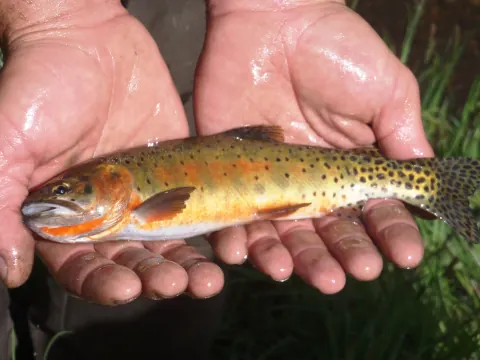
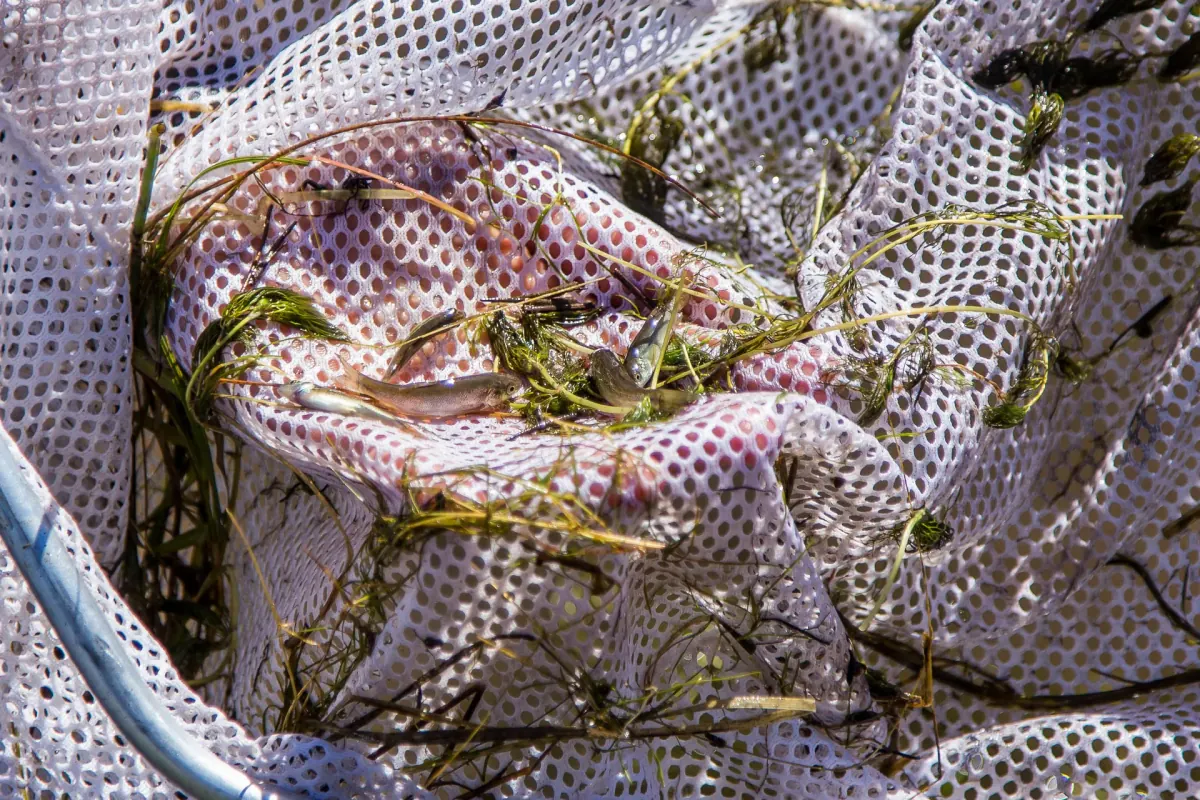
The Rio Grande sucker is a small native fish of the San Luis Valley’s mountain streams. It is state endangered in Colorado after losing as much as 90% of its range, though restocking has helped it hold on.
Colorado lists the Rio Grande sucker as State Endangered. It is not federally listed: in 2024, the U.S. Fish and Wildlife Service found that listing was not warranted.
CPW counted seven self-sustaining populations in late 2023, and in 2024 Colorado Outdoors reported eight established populations plus several promising reintroduction sites.
Name
The Rio Grande sucker’s scientific name is Pantosteus plebeius. It was formerly classified as Catostomus plebeius, and older sources still use that name. USFWS uses Pantosteus in its 2024 finding.
Natural History
The Rio Grande sucker is a small sucker, usually under about 8 inches (200 mm) long.
It is a bottom grazer. It scrapes algae and other growth off rocks with a hard ridge on its jaw.
It prefers low-gradient stream reaches with shallow, low-to-moderate flow and little fine sediment.
Rio Grande suckers spawn in spring, at about 11–16 °C (52–61 °F), as flows drop after peak runoff. They mature at 1 to 3 years and live about 3 to 7 years; the 7-year figure comes from New Mexico.
Habitat and Range
USFWS counted 32 Rio Grande sucker populations in the United States, occupying 605.7 kilometers (376.4 miles) of stream. It describes the species as “found predominantly in montane stream environments in the upper Rio Grande basin in north-central New Mexico and south-central Colorado.”
That count of 32 is a total for the United States, not for Colorado.
Decline
The Rio Grande chub and Rio Grande sucker were once “some of the most common fishes.” Declines appeared as early as the late 1800s, from dewatering, habitat degradation and invasive species.
In the words of CPW biologist Daniel Cammack: “Rio Grande suckers are a state endangered species, whose occupancy has declined as much as 90%.”
Primary Threats
Across the species’ range:
Nonnative white suckers
White suckers compete with Rio Grande suckers and can hybridize with them. White sucker invasions have wiped out Rio Grande sucker populations.
Water diversions
Researchers identified 249 water diversions in the species’ range, and about 24% of them are complete barriers to fish movement.
Other threats
Nonnative trout, drought and wildfire also threaten populations.
The Rio Grande chub, by contrast, is a native companion species, not a threat.
Recovery & Conservation
State status
The Rio Grande sucker is listed as State Endangered under Colorado regulations (2 CCR 406-10, §1002), and it was already state endangered by 1999.
Federal review
WildEarth Guardians petitioned for federal listing on October 3, 2014. On June 20, 2024, USFWS found that listing was not warranted (89 FR 51864), in the same notice as the Rio Grande chub.
Restocking
Since 2002, CPW’s John W. Mumma Native Aquatic Species Restoration Facility in Alamosa has stocked nearly 450,000 Rio Grande suckers into 20 waters.
Reclaiming streams
Over three decades, CPW and its partners completed five chemical reclamations, which remove nonnative fish, along with habitat and connectivity projects.
A new home at Great Sand Dunes
On September 26, 2023, CPW, USFWS and Great Sand Dunes National Park moved more than 600 Rio Grande chub and sucker from Crestone Creek on the Baca National Wildlife Refuge to Big Spring Creek on the park’s Medano Ranch, about 20 miles south. The Crestone Creek population, found in the early 2000s, was then one of only two known populations of both species. Big Spring Creek is fed by springs averaging about 5 cubic feet per second.
Planning
A Conservation Agreement with 12 signatories, including CPW, was finalized in 2018. The Rio Grande Chub and Sucker Conservation Team adopted species conservation strategies in 2021.
What You Can Do
- Never move live fish or bait between waters.
- Clean, drain and dry boats and gear.
- Know your fish. Learn the difference between native and nonnative fish, and follow CPW fishing regulations.
Sources
- CPW, threatened and endangered wildlife list
- Colorado Natural Heritage Program (1999), state-listed species report
- Federal Register (2024), three species not warranted for listing
- USFWS (2024), Rio Grande chub and sucker not in danger of extinction
- CPW (2023), CPW, USFWS and Great Sand Dunes partner to expand Rio Grande chub and sucker populations
- Colorado Outdoors (2024), partnership protects Rio Grande chub and Rio Grande sucker
- USGS Nonindigenous Aquatic Species, Rio Grande sucker fact sheet
- USFWS, Rio Grande sucker species status assessment